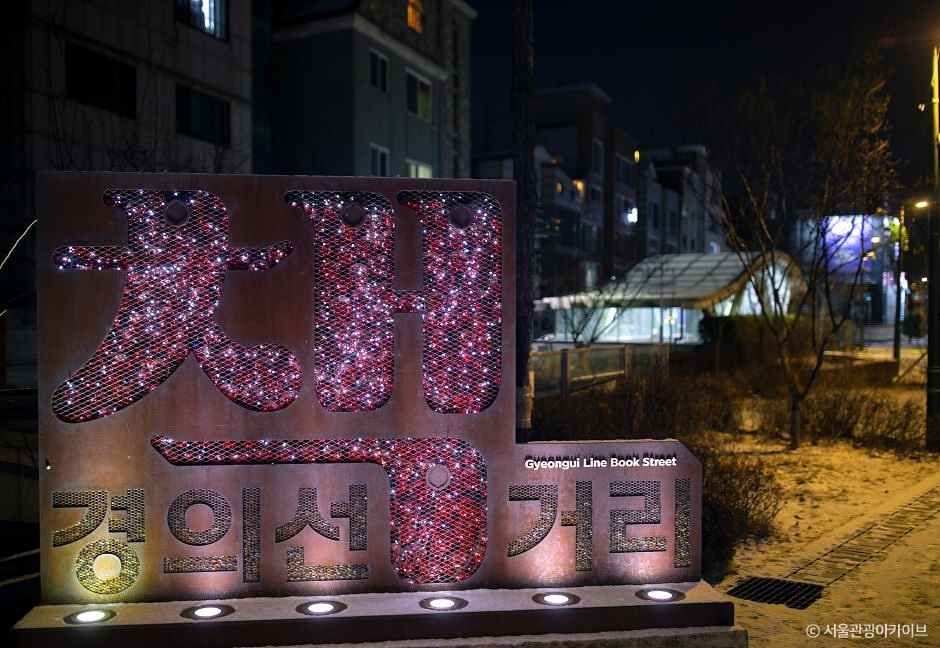
G-line Book Street
Gyeongui Line Book Street is a book-themed street created on the abandoned Gyeongui Line railway site at Hongdae Complex Station to revive the book culture of the Jeongjo era in the late 18th century, when governance through books was pursued, and to provide citizens with a complex cultural space centered on books. It serves as a starting point where visitors to Gyeongui Line Book Street can share wisdom for healthy living through the great value of books, realize their dreams, and enhance the added value of Mapo's publishing industry.
Gyeongui Line Book Street is a book-themed street created on the abandoned Gyeongui Line railway site at Hongdae Complex Station to revive the book culture of the Jeongjo era in the late 18th century, when governance through books was pursued, and to provide citizens with a complex cultural space centered on books. It was completed in October 2016 with the hope that visitors to Gyeongui Line Book Street will share wisdom for healthy living through the great value of individual books, realize their dreams, and serve as a starting point to enhance the added value of Mapo's publishing industry.
Operating
- ParkingNo
- Open hours11:00~20:00
- Closed days매주 월요일
- Reservation requiredUnknown
- Walk-in allowedUnknown
Payment
- Card paymentNo
- Foreign cardUnknown
- Cash onlyUnknown
Languages
- KoreanYes
- EnglishYes
- JapaneseYes
- Simplified ChineseYes
- Multilingual signageUnknown
Accessibility
- Wheelchair accessUnknown
- Stroller accessUnknown
- Accessible restroomYes
- Accessible parkingYes
- ElevatorUnknown
Location
서울특별시 마포구 와우산로37길 35
Cross-check the address on the platform you trust.
Similar places
- attraction
Yanghwajin Foreign Missionary Cemetery
Yanghwajin Foreign Missionary Cemetery is where missionaries who devoted themselves to this land as seeds of the Gospel are buried. It houses 417 missionaries from 15 countries including South Africa, New Zealand, Denmark, Germany, and the United States. These missionaries dedicated their lives for the Korean people during the dark period of Japanese colonial rule, coming to share the light of the Gospel in countries that were less known to the world at that time. As contributors to missionary activities and Korean social work, they had profound impacts on the Korean people not only through social institutions such as the establishment of hospitals and schools, but also in intangible spiritual realms such as the abolition of the class system and the patriarchal custom of male superiority.
- attraction
Jeoldusan Martyrs' Shrine
Jeoldusan was originally called Jamduobong, said to resemble the head of a silkworm. In February 1866, a French military vessel sailed up the Han River to Yanghwajin and Seokgang, raising issues about the persecution of Catholics. Angered by this, the Daewongun had numerous Catholics beheaded at Jamduobong. Subsequently, the place became known as Jeoldusan (切頭山), meaning 'the mountain where heads were cut.' The Korean Catholic Church opened a Martyrs' Memorial Hall in October 1967 to commemorate the 100th anniversary of the Byeonginhohae persecution (1866)…
ENZH - attraction
Mangwonjeong Pavilion
A pavilion located in Hapjeong-dong that is designated as a Seoul Historical Monument and has been restored and maintained since October 1989. In the 6th year of King Sejong's reign (1424), Prince Hyoryeong built a villa, and the following year when King Sejong visited the pavilion while inspecting agricultural affairs in Seogyo, rain fell and it was named 'Heuiujung.' In the 15th year of King Seongjong's reign (1484), Prince Wolsan greatly renovated the pavilion and renamed it Mangwonjung. In the 12th year of King Yeonsan's reign in July, it was expanded to accommodate about 1,000 people and changed to…
- attraction
Mangwon Hangang Park
Mangwon Hangang Park, a rest area for Seoul citizens among the Hangang Citizen Parks, is located on the north bank of the river between Wonhyo Bridge and Seongsan Bridge, adjacent to Mapo-gu. The floodplain is well-equipped with rest spaces such as lawns and walking paths, and various sports facilities and bicycle paths are provided. You can visit with friends or lovers to enjoy leisure time. Water leisure activities such as windsurfing, water skiing, and motorboats take place on the water, and in the surrounding area there are cultural heritage sites such as Mangwonjeong and Jeoldusa…
EN