seoul · attraction

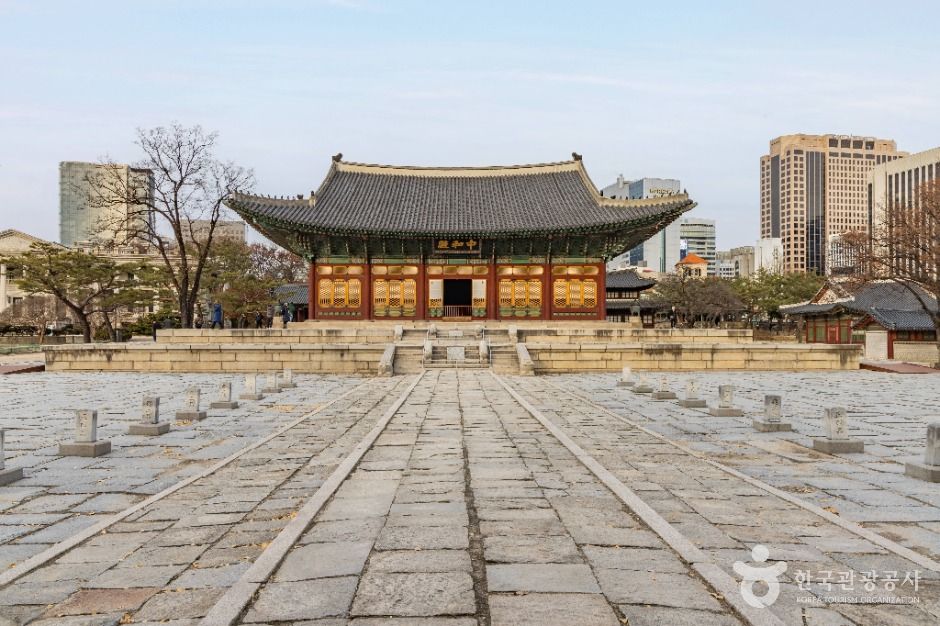
Deoksugung Palace's Daehanmun Gate

Deoksugung is the imperial palace of the Korean Empire, proclaimed in 1897, and was formerly known as Gyeongungung. Deoksugung was originally the private residence of Wolsan Daekun, the older brother of the 9th king of Joseon, Seongjong, and later served as the residence of Wolsan Daekun's descendants. When all the palaces in the capital were destroyed during the Imjin War in 1592 (the 25th year of King Seonjo's reign), it began to be used as a temporary palace from 1593 (the 26th year of King Seonjo's reign) and was called Jeongneungdong Haenggung (貞陵洞 行宮). Subsequently, in 1611 (the 3rd year of King Gwanghaegun's reign), it was officially named Gyeongungung (慶運宮) and became a formal palace, but later became a secondary palace when Changdeokgung was reconstructed.

Deoksugung Palace is stroller-accessible with barrier-free routes, making it manageable for families with young children.
멜라 mella and 5 other creators featured this place

Deoksugung is the imperial palace of the Korean Empire, proclaimed in 1897, and was formerly known as Gyeongungung. Deoksugung was originally the private residence of Wolsan Daekun, the older brother of the 9th king of Joseon, Seongjong, and later served as the residence of Wolsan Daekun's descendants. When all the palaces in the capital were destroyed during the Imjin War in 1592 (the 25th year of King Seonjo's reign), it began to be used as a temporary palace from 1593 (the 26th year of King Seonjo's reign) and was called Jeongneungdong Haenggung (貞陵洞 行宮). Subsequently, in 1611 (the 3rd year of King Gwanghaegun's reign), it was officially named Gyeongungung (慶運宮) and became a formal palace, but later became a secondary palace when Changdeokgung was reconstructed. Then, in 1897 (the 1st year of Gwangmu), when King Gojong proclaimed the Korean Empire and ascended to the imperial throne, it was used as the imperial palace of the Korean Empire. Afterward, the scale was expanded and the formality was elevated to suit an imperial palace, and Western-style buildings began to be constructed within the palace, creating a harmony between traditional and Western architectural structures. However, many buildings were destroyed by a major fire in 1904 (the 8th year of Gwangmu), and in 1907, when King Gojong was forced to abdicate by the Japanese colonial authorities, the name of the palace was changed to Deoksugung. After the Japanese colonial period, the scale of Deoksugung was drastically reduced and most of the buildings were demolished. At the same time, it underwent conversion into a park and lost its character as a palace. In 1946-47, the first and second sessions of the Soviet-American Joint Commission were held at Deoksugung Seokjojeon (the Stone Building). Subsequently, restoration of Deoksugung was steadily carried out, resulting in its current appearance.

Travelers often ask

Rainy day

Deoksugung is mainly an outdoor palace, but it has several indoor exhibition halls that work as rain shelters.

  • Place type: palace attraction; main grounds are outdoor
  • Indoor halls open during the day: Seokjojeon, Dondeokjeon, Jungmyeongjeon
  • General visiting hours 09:00–21:00 (last entry 20:00)
  • Closed Mondays (with public-holiday exceptions)
  • No on-site parking — relevant if arriving in the rain
  • Step-free route, wheelchair and stroller accessible

Based on place_type (attraction/palace) and operating.open_hours_raw which lists indoor exhibition halls; experience_attributes.indoor_outdoor and rain_safe are null, so the indoor/outdoor characterization is inferred from the listed hall names rather than an explicit rain-safe flag. Parking and closed-day info from operating fields.

Family trip

Deoksugung Palace is stroller-accessible with barrier-free routes, making it manageable for families with young children.

  • Stroller access: available
  • Barrier-free route through the palace grounds
  • Accessible restrooms on site
  • No on-site parking available
  • Approach route has some slopes
  • General visiting hours 09:00–21:00 (last entry 20:00), closed Mondays

Based on accessibility.stroller_access, accessibility.barrier_free_route, accessibility.restroom_accessible, accessibility.public_transport_accessible, operating.parking_available, and operating.open_hours_raw. experience_attributes.child_friendly_level, accessibility.lactation_room, and accessibility.highchair_available were not provided, so child-specific amenities are not confirmed.

Language support

Deoksugung Palace offers support in Korean, English, and Simplified Chinese, plus sign language guides and human guide assistance.

  • Korean, English, and Simplified Chinese supported
  • Japanese-language support not specified
  • Sign language guide available
  • Human guide service available
  • Audio guide availability not specified
  • Multilingual signage status not specified

Based on language_support (korean, english, chinese_simplified) and accessibility.sign_language_guide and accessibility.human_guide_available. Fields for japanese, multilingual_signage, translation_menu_available, and audio_guide were null, so those points are reported as unspecified.

Accessibility

Deoksugung Palace offers wheelchair and stroller access, a barrier-free route, an accessible restroom, and sign language guidance.

  • Wheelchair and stroller access available
  • Barrier-free route through the site
  • Accessible restroom on site
  • Sign language guide and human guide assistance offered
  • Approach paths include some slopes
  • No on-site parking; accessible parking info not specified

Based on accessibility.wheelchair_access, stroller_access, barrier_free_route, restroom_accessible, sign_language_guide, human_guide_available, public_transport_accessible, and operating.parking_available. Braille guide, audio guide, tactile map, elevator, and parking_accessible were null in the source.

Operating

  • ParkingNo
  • Open hours[일반관람] - 09:00~21:00 (입장마감 20:00) [전시관] - 석조전 09:30~17:30 (마지막 해설 16:30) - 돈덕전 09:00~17:30 (입장마감 17:00) - 중명전09:30~17:30(입장마감 17:00)
  • Closed days매주 월요일 ※ 단, 정기휴일이 공휴일 및 대체공휴일과 겹칠 경우에는 개방하며, 그 다음의 첫 번째 비공휴일이 정기휴일임
  • Reservation requiredUnknown
  • Walk-in allowedUnknown

Payment

  • Card paymentUnknown
  • Foreign cardUnknown
  • Cash onlyUnknown

Languages

  • KoreanYes
  • EnglishYes
  • JapaneseUnknown
  • Simplified ChineseYes
  • Multilingual signageUnknown

Accessibility

  • Wheelchair accessYes
  • Stroller accessYes
  • Accessible restroomYes
  • Accessible parkingUnknown
  • ElevatorUnknown

Similar places

Chats
아직 저장된 대화가 없습니다.
새 채팅을 시작하면 여기에 모입니다.