seoul · attraction

Haepungbuwongun Yun Taekyeong's Jaesil

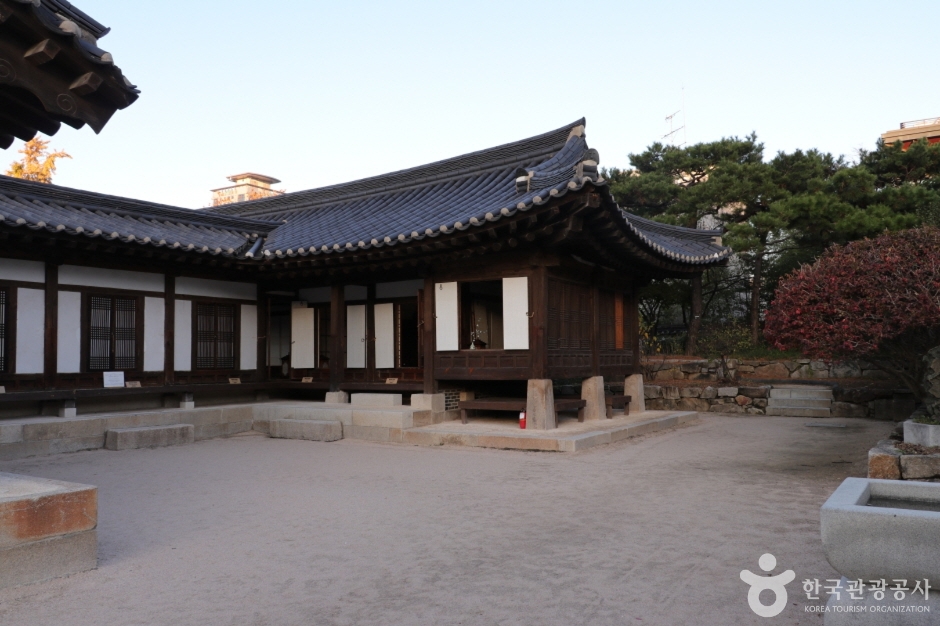
This house was built by Yun Taek-yeong, Lord of Haepung and father-in-law of King Sunjong, when his daughter, Queen Sunjong, was appointed as Crown Princess in 1906 and entered Changdeokgung Palace. The building materials were timber from the dismantling of Gyeongungung Palace, made of Korean pine. It was originally located at 224 Jegi-dong, Dongdaemun-gu and was relocated and restored to its current site. The house plan has a rare primary circular (元) shape in Korea. The ㅡ-shaped ancestral shrine is positioned at the head of the circle on the highest terrace…

This house was built by Yun Taek-yeong, Lord of Haepung and father-in-law of King Sunjong, when his daughter, Queen Sunjong, was appointed as Crown Princess in 1906 and entered Changdeokgung Palace. The building materials were timber from the dismantling of Gyeongungung Palace, made of Korean pine. It was originally located at 224 Jegi-dong, Dongdaemun-gu and was relocated and restored to its current site. The house plan has a rare primary circular (元) shape in Korea. The ㅡ-shaped ancestral shrine is positioned at the head of the circle, occupying the innermost and highest terrace of the house. In front of it, on a terrace one level lower to the south, is placed the ㅠ-shaped main body of the circle. The structure of the main body consists of the inner quarters and the master's quarters connected in series, forming the ㅡ of the ㅠ, and in front, the corridor buildings extend east and west, forming the arms in continuous connection. The ancestral shrine was restored after being destroyed in 1960, and a tiered stone foundation was built in two stages in front of the shrine to form a decorative planter garden. The center of the circular plan naturally becomes the central courtyard; a wall is built along the wall line of the corridor buildings to the east and west in front, with a corner gate to enter the courtyard. The inner courtyard is entered through the side gate of the western corridor, and the master's courtyard is entered through a corner gate in the wall extending from the end of the eastern corridor. The roof is a hip-and-gable tile roof; the master's quarters has a double eave with extended rafters, while the rest have single eaves. The corridor buildings form a gable roof with a three-beam frame structure. The overall atmosphere of the house is suited more to an ancestral shrine residence rather than an ordinary dwelling. Consequently, it is a house with many special features, such as the large reception room positioned in the center and the inner and master's quarters facing each other.

Travelers often ask

Language support

English signage and staff support available; Korean is the primary language.

  • English signage and staff support are available
  • Korean is the primary language of operation
  • Japanese, Chinese simplified, and Chinese traditional are not listed as supported
  • No audio guide or sign language guide services are documented
  • Limited to English and Korean language assistance

Based on language_support.korean and language_support.english fields; all other language fields (japanese, chinese_simplified, chinese_traditional) are null. Accessibility fields for audio_guide and sign_language_guide are null. Answer is limited to what the data explicitly confirms.

Operating

  • ParkingNo
  • Open hours- 하절기 09:00~21:00 - 동절기 09:00~20:00
  • Closed days매주 월요일
  • Reservation requiredUnknown
  • Walk-in allowedUnknown

Payment

  • Card paymentUnknown
  • Foreign cardUnknown
  • Cash onlyUnknown

Languages

  • KoreanYes
  • EnglishYes
  • JapaneseUnknown
  • Simplified ChineseUnknown
  • Multilingual signageUnknown

Accessibility

  • Wheelchair accessUnknown
  • Stroller accessUnknown
  • Accessible restroomUnknown
  • Accessible parkingUnknown
  • ElevatorUnknown
Chats
아직 저장된 대화가 없습니다.
새 채팅을 시작하면 여기에 모입니다.