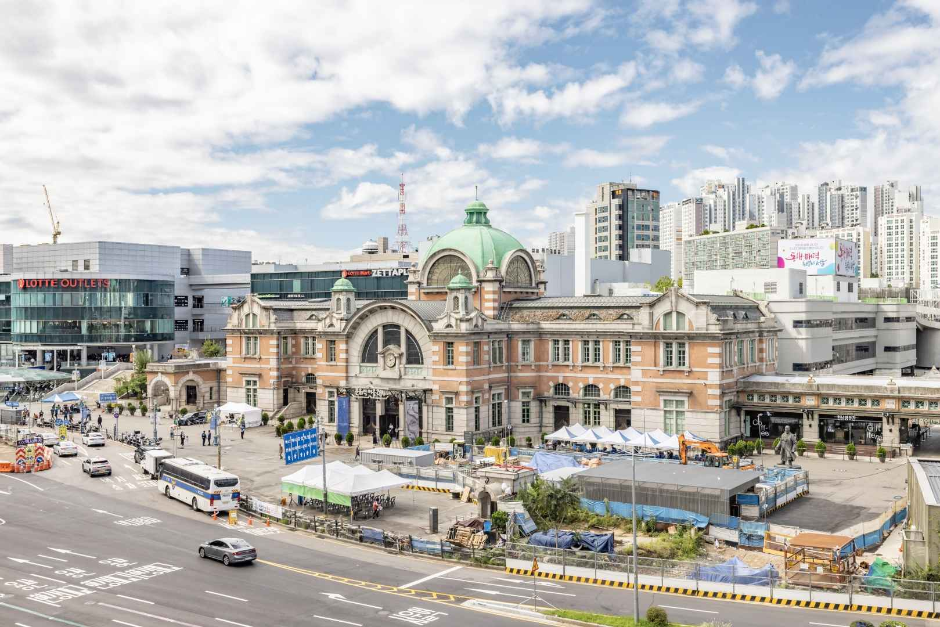
Culture Station Seoul 284
Culture Station Seoul 284 is a complex cultural space created by restoring the original form of the old Seoul Station, which was a major stage in Korean modern and contemporary history and a gateway for transportation and exchange. As a platform for cultural and artistic creation and exchange, it hosts diverse programs including exhibitions, performances, and workshops. Beginning with Namdaemun Station in 1900, it became Gyeongseong Station and then Seoul Station before the old station building closed in 2004 and transformed into a new space. The building's exterior was restored to recreate the 1925 Gyeongseong Station...
Culture Station Seoul 284 is a complex cultural space created by restoring the original form of the old Seoul Station, which was a major stage in Korean modern and contemporary history and a gateway for transportation and exchange. As a platform for cultural and artistic creation and exchange, it hosts diverse programs including exhibitions, performances, and workshops. Beginning with Namdaemun Station in 1900, it became Gyeongseong Station and then Seoul Station before the old station building closed in 2004 and transformed into a new space. The building's exterior was restored to recreate the 1925 Gyeongseong Station. With its exotic European Renaissance-style exterior featuring red brick, granite flooring, walls with artificial stone, and birch wood flooring, it has gained popularity. ◎ Travel Information for Experiencing the Charm of Korean Wave This is the place where Mok-ha (played by Park Eun-bin) in the drama waited for Gi-ho (played by Chae Jong-hyeop) holding flowers. As it restored the old Seoul Station, the drama features it as the location where Samcheonpo (played by Kim Sung-kyun) arrived in Seoul.
Operating
- ParkingNo
- Open hours11:00~19:00 (입장 마감 : 관람 종료 1시간 전)
- Closed days매주 월요일 ※전시 기간 확인 후 방문 요망(전시 준비 기간 미운영)
- Reservation requiredUnknown
- Walk-in allowedUnknown
Payment
- Card paymentYes
- Foreign cardUnknown
- Cash onlyUnknown
Languages
- KoreanYes
- EnglishYes
- JapaneseUnknown
- Simplified ChineseYes
- Multilingual signageUnknown
Accessibility
- Wheelchair accessYes
- Stroller accessUnknown
- Accessible restroomYes
- Accessible parkingYes
- ElevatorYes
Location
서울특별시 중구 통일로 1 (봉래동2가)
Cross-check the address on the platform you trust.
Similar places
- attraction
Myeong-dong, Namdaemun, Bukchang-dong, Da-dong and Mugyo-dong Special Tourist Zone
The Myeongdong, Namdaemun, Bukchangdong, Dadong, and Mugyo-dong Tourism Special Zone refers to shopping and food destinations in the central Seoul area that attract many foreign visitors. It is a representative commercial and financial center of the Republic of Korea and the premier destination for shopping, culture, art, and fashion, housing department stores such as Lotte Department Store, Shinsegae Department Store, Myeongdong Millioré, and Samik Fashion Town. Here you can enjoy a variety of shopping ranging from luxury brands to wholesale clothing...
EN - attraction
Myeong-dong, Namdaemun, Bukchang-dong, Da-dong and Mugyo-dong Special Tourist Zone
Sungnyemun is the south gate of the Joseon fortress city located at Namdaemun-ro 4-ga, Jung-gu, Seoul. Also called Namdaemun, it is positioned at the south among the Four Great Gates and is a symbol of Seoul and the oldest existing wooden structure in Seoul. It was designated as a National Treasure on December 20, 1962. It is characterized by being the largest in scale among Seoul's Four Great Gates and having its plaque inscribed vertically. It was first constructed in the 5th year of King Taejo (1396) and rebuilt in February 1398.
EN - attraction
Namdaemun Market Galchi-jorim (Simmered Largehead Hairtail) Alley
Namdaemun Galchi Jorim Alley formed around 1988. At that time, affordable galchi (cutlassfish) was stewed spicy and pungently to suit merchants' tastes, and through media coverage and word-of-mouth, it became famous as a must-try food. Originally, this area was a restaurant district rather than an alley specialized in galchi jorim. Heullak Restaurant and Wangseong Restaurant were the first to specialize in galchi jorim on their menu, and as galchi jorim gained fame, surrounding shops one by one changed their signboards to galchi jorim.
- attraction
Deoksugung Palace's Daehanmun Gate
Deoksugung is the imperial palace of the Korean Empire, proclaimed in 1897, and was formerly known as Gyeongungung. Deoksugung was originally the private residence of Wolsan Daekun, the older brother of the 9th king of Joseon, Seongjong, and later served as the residence of Wolsan Daekun's descendants. When all the palaces in the capital were destroyed during the Imjin War in 1592 (the 25th year of King Seonjo's reign), it began to be used as a temporary palace from 1593 (the 26th year of King Seonjo's reign) and was called Jeongneungdong Haenggung (貞陵洞 行宮). Subsequently, in 1611 (the 3rd year of King Gwanghaegun's reign), it was officially named Gyeongungung (慶運宮) and became a formal palace, but later became a secondary palace when Changdeokgung was reconstructed.
ENZH