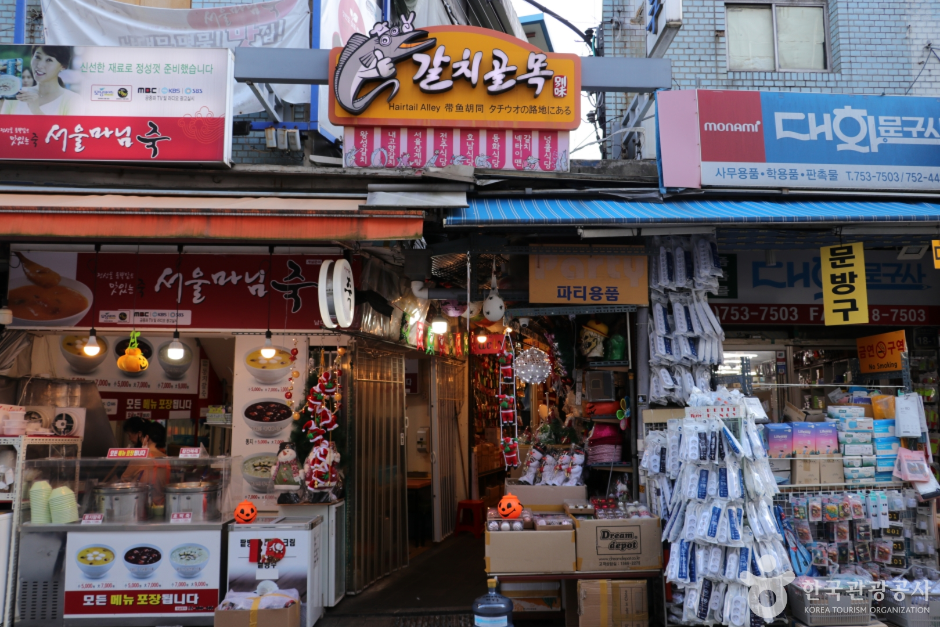
Namdaemun Market Galchi-jorim (Simmered Largehead Hairtail) Alley
Namdaemun Galchi Jorim Alley formed around 1988. At that time, affordable galchi (cutlassfish) was stewed spicy and pungently to suit merchants' tastes, and through media coverage and word-of-mouth, it became famous as a must-try food. Originally, this area was a restaurant district rather than an alley specialized in galchi jorim. Heullak Restaurant and Wangseong Restaurant were the first to specialize in galchi jorim on their menu, and as galchi jorim gained fame, surrounding shops one by one changed their signboards to galchi jorim.
Namdaemun Galchi Jorim Alley formed around 1988. At that time, affordable galchi (cutlassfish) was stewed spicy and pungently to suit merchants' tastes, and through media coverage and word-of-mouth, it became famous as a must-try food. Originally, this area was a restaurant district rather than an alley specialized in galchi jorim. Heullak Restaurant and Wangseong Restaurant were the first to specialize in galchi jorim on their menu, and as galchi jorim gained fame, surrounding shops one by one changed their signboards to galchi jorim. Merchants purchase raw ingredients directly and provide side dishes made in-house. Selecting galchi among the raw materials is said to be most important. While the galchi sources used vary somewhat by restaurant, they use premium-quality domestic galchi such as Yeosu galchi, Jeju galchi, Mokpo galchi, and Busan galchi. Additionally, there are slight differences in the cooking methods for galchi, so even though it is called galchi jorim, each restaurant offers its own unique taste. Named a signature alley of Namdaemun Market, the largest traditional market in Korea, Galchi Jorim Alley has become an essential lunch destination for office workers and merchants around Namdaemun Market, and a place people return to after their first visit. Following coverage by Japanese media, the number of Japanese tourists has increased. It is said that some tourists who tasted galchi jorim were so impressed by the flavor that they kept business cards and returned to visit when they came back to Korea. For those who find galchi jorim too spicy, there are restaurants that also sell grilled fish.
Operating
- ParkingYes
- Open hours점포 별로 상이함
- Closed days점포 별로 상이함
- Reservation requiredUnknown
- Walk-in allowedUnknown
Payment
- Card paymentNo
- Foreign cardUnknown
- Cash onlyUnknown
Languages
- KoreanYes
- EnglishUnknown
- JapaneseUnknown
- Simplified ChineseUnknown
- Multilingual signageUnknown
Accessibility
- Wheelchair accessUnknown
- Stroller accessUnknown
- Accessible restroomUnknown
- Accessible parkingUnknown
- ElevatorUnknown
Location
서울특별시 중구 남대문시장길 16-17 (남창동)
Cross-check the address on the platform you trust.
Similar places
- attraction
Myeong-dong, Namdaemun, Bukchang-dong, Da-dong and Mugyo-dong Special Tourist Zone
The Myeongdong, Namdaemun, Bukchangdong, Dadong, and Mugyo-dong Tourism Special Zone refers to shopping and food destinations in the central Seoul area that attract many foreign visitors. It is a representative commercial and financial center of the Republic of Korea and the premier destination for shopping, culture, art, and fashion, housing department stores such as Lotte Department Store, Shinsegae Department Store, Myeongdong Millioré, and Samik Fashion Town. Here you can enjoy a variety of shopping ranging from luxury brands to wholesale clothing...
EN - attraction
Myeong-dong, Namdaemun, Bukchang-dong, Da-dong and Mugyo-dong Special Tourist Zone
Sungnyemun is the south gate of the Joseon fortress city located at Namdaemun-ro 4-ga, Jung-gu, Seoul. Also called Namdaemun, it is positioned at the south among the Four Great Gates and is a symbol of Seoul and the oldest existing wooden structure in Seoul. It was designated as a National Treasure on December 20, 1962. It is characterized by being the largest in scale among Seoul's Four Great Gates and having its plaque inscribed vertically. It was first constructed in the 5th year of King Taejo (1396) and rebuilt in February 1398.
EN - attraction
Deoksugung Palace's Daehanmun Gate
Deoksugung is the imperial palace of the Korean Empire, proclaimed in 1897, and was formerly known as Gyeongungung. Deoksugung was originally the private residence of Wolsan Daekun, the older brother of the 9th king of Joseon, Seongjong, and later served as the residence of Wolsan Daekun's descendants. When all the palaces in the capital were destroyed during the Imjin War in 1592 (the 25th year of King Seonjo's reign), it began to be used as a temporary palace from 1593 (the 26th year of King Seonjo's reign) and was called Jeongneungdong Haenggung (貞陵洞 行宮). Subsequently, in 1611 (the 3rd year of King Gwanghaegun's reign), it was officially named Gyeongungung (慶運宮) and became a formal palace, but later became a secondary palace when Changdeokgung was reconstructed.
ENZH - attraction
Deoksugung Palace's Daehanmun Gate
Daehanmun (大漢門) is the main gate of Deoksugung. The name 'Daehan' means 'Hanyang becomes prosperous.' Originally, the main gate of Gyeongungung was Inhwamun (仁化門) located to the south, but as the area around Daeanmun (大安門), the eastern gate, took on the role of a new urban center including Hwanggudan, it began to serve as the main gate. The current name was given in 1906 (Gwangmu 10) when the gate was repaired. Originally, Daehanmun stood approximately 33 meters ahead, but during the expansion of Taepyeongno in the 1970s...
ENZH